June 2026
Borrowed Returns
On compounding attention, taste, and the decade of investment.
The money advice you inherit describes a world that has mostly already closed. What's left is harder, though more honest.
A friend's father told him last year to put it all in an index fund and not look at it for thirty years because that is what worked for him. He isn't wrong about what worked for him to be honest, he bought into an American market in the early 80s and got to watch it climb, through every crash and panic along the way, for the better part of four decades, and by the time he was handing the advice he had the account balance to back it up. Logically, there's no lies in what he's suggesting or saying but it's out of time.
I've spent the last couple of years close to money that is trying to grow, in crypto, around funds and in the part of my own head that reads too many quarterly letters & investor updates, and the most useful thing I've concluded on is that most of what gets passed down as investing wisdom is survivorship reporting from some sort of boom. It is true, just doesn't hold the weight the people repeating it think it holds.
Start with what the boom actually was, because once I always wonder about this and try to observe. Someone who bought broad American equities around 1982 and held caught four things at once, none of which they arranged. They caught the back half of the American century, when the United States was simply where the rest of the world's savings wanted to be. They caught globalization, the decade or two when a couple of billion people walked into the labor force and the supply chain and made everything cheaper to build and easier to sell. They caught a 40 year fall in interest rates, from around 15% in the early 80s to roughly 0% by 2020 and falling rates lift the price of every asset on earth. And they caught the computing curve, from the first PCs to the screen you're reading this on. Four enormous tailwinds, stacked, running for one human working life. If you were a body in that water, you did well, and everything must have felt like a skill. Mostly it was timing - being born in the right decade in the right country and not panicking at the wrong moments.
This was a regime and not a law of nature is sitting in plain sight and almost no one under 40 has maybe observed with it? In December 1989 the Nikkei closed at 38,915. A Japanese person who did everything we now tell young people to do, bought the broad index, held through the fear, trusted that markets always come back, got back to even in February 2024 (after 34 years!). A whole working life of time in the market and in price terms it returned nothing.
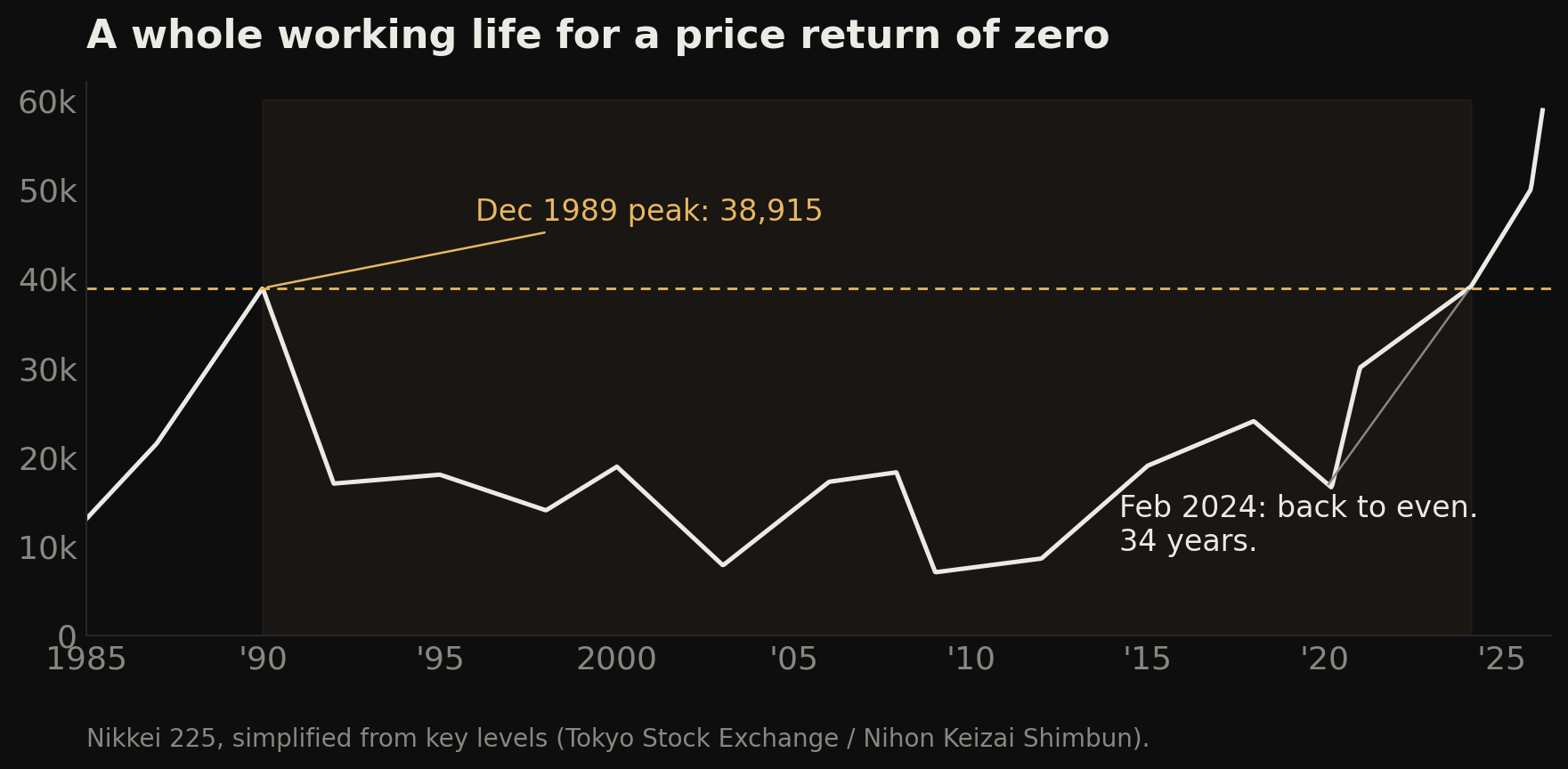
In 1989, 32 of the 50 largest companies in the world were Japanese and the only American name near the top was Exxon. Today exactly one Japanese company, Toyota, sits in that global top 50. The land under the Imperial Palace was said to be worth more than all of California. I don't think any of those people were fools, they were standing in the same water the Americans were standing in, except their tide went out and stayed out for a generation. The Nikkei chart belongs taped above the desk of anyone who thinks holding is a strategy rather than a bet on one particular future.
So then why does the inherited advice fail now (and didn't before?), even setting aside the chance of a Japan happening to you? Because young systems and old systems pay you in completely separate ways and the advice was written for a young one.
When a market is early, almost everything in it rises together. You could buy nearly any internet company in 1996, or nearly any token in 2017, and the move carried you regardless of whether you'd chosen well because the whole category was being repriced from nothing to something and the category itself was the bet. Spreading your money across the entire field was close to free because the field was winning. That is the world where invest in indexes and wait advice was minted in and inside that world it was genuinely good advice.
What happens as a market grows up is that it stops paying everyone and starts paying a few.
The returns concentrate.
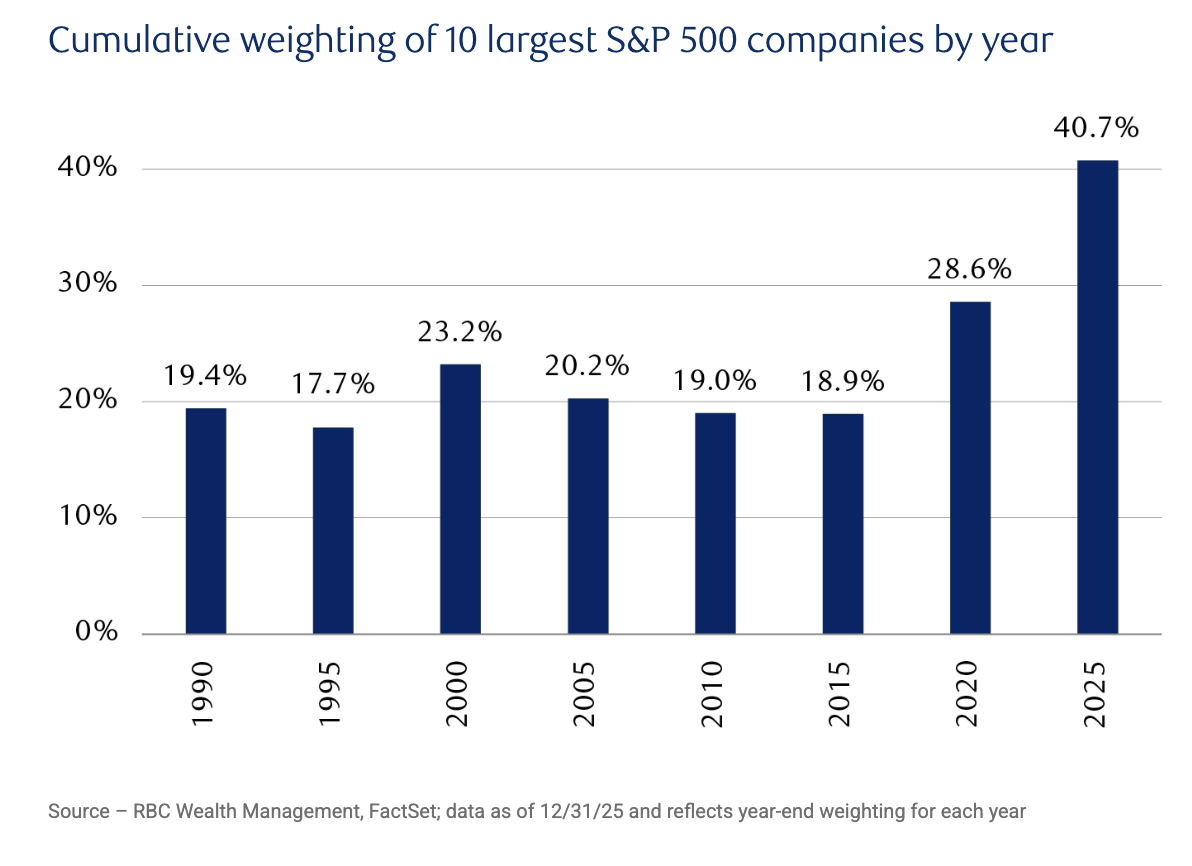
A handful of winners take almost all of it while the median company in the index goes sideways or dies, and the diversified basket you own slowly turns into the weight of 5 or 6 giant firms that are now most of your return. Owning everything stops being a way to capture a rising whole and becomes a way to water down your few good ideas with a long tail of dead ones. The same math that made diversification a free lunch when the system was young turns it into dead weight once the easy growth is spent. I don't think this is a clever theory, it's in my opinion how market naturally just matures or normalises.
In 2025, the S&P returned about 16% which sounds fine until you see it came near the bottom of the global table behind most of the world. India (where I'm invested heavily in public markets), the consensus best growth story on the planet and the market every allocator had already crowded into, lost money for a lot of funds; the average India equity fund fell close to 9% and India's economy is NOT broke, I just think everyone had already paid in advance for the good news (which is yet to materialise for the most part).
The best performing stock market on earth was Colombia, up more than 90%. A mature, picked over world pays like that. The reward sits wherever the crowd isn't, and the crowd was in America and India and definitely not Bogota.
Which is the same as saying the inherited move, own everything and wait, is a pure beta playbook being handed to you at the exact moment beta has been competed away.
After all that rambling, I do want to say this to the people of my age, and I want to say it without the swagger this kind of take usually arrives with because I might be wrong about the magnitude and I'm not wrong about the direction.
Split the money into two piles.
The first pile is the money whose only job is to not die and to roughly keep pace. Own the broad thing for that, sure. But go in clear eyed that you are buying a mature system and not a young one, and that the next thirty years almost certainly will not rhyme with the last 30. Size your expectations to include a Nikkei-shaped outcome (pls!) not just an S&P-shaped one.
The second pile is the money that is supposed to change your life and here the hard freeing fact is that you now need the one thing that our parents or older generation of investors never needed, want to take a guess? Well, drum rolls... an edge. For them, they pulled life-changing numbers out of ordinary participation because the era did the work for them.
You most definitely won't. To pull those numbers now you have to understand some specific thing better than the people setting its price, or be early to a curve before it's obviously a curve or simply have the nerve to buy what nobody wants because you can explain why and they can't. That is insanely harder than holding an index but I feel it is also the only door still open, and thinking past it right now is the most expensive thing you can do with a (your) young person's years.
Underneath all of it is the one question that hasn't changed and never will.
The wrapper changes every decade - it was blue chips, then index funds, real estate, then venture, then crypto, then whatever is being born right now with AI and people fight bitterly over which wrapper is THE one as though the wrapper were the point.
The question under every one of them is identical and that's how I think about it, is that does this thing produce real value, and am I early or right about it before the crowd.
You don't get to skip these decisions. More so, financial decisions because sitting a lot of these decisions out because our parents or previous generation of investors said so, will most likely have you miss one of the largest wealth generation events in history; you just need to find it real hard.
For my Indian friends: behti Ganga mein haath dho lena.
For my fellow non-indians:When the river's flowing, wash your hands. And for this generation, find that river first. Not every river is Ganga.
It might be the most level playing field anyone's had in 50 years (an example I love to quote is Leopold Aschenbrenner, more here). The returns flow back toward thinking instead of toward timing you were never going to control and the people who do well from here will mostly be the ones who ACTUALLY understood something and have a non-consensus thesis.
Being young and curious in this world beats being young in one where the only winning move was to have been born earlier. So have fun with your own non-consensus thesis, the borrowed returns are spent.
From here you make your own.
Z